| What Color is Jupiter |
| Top |
 |
 |
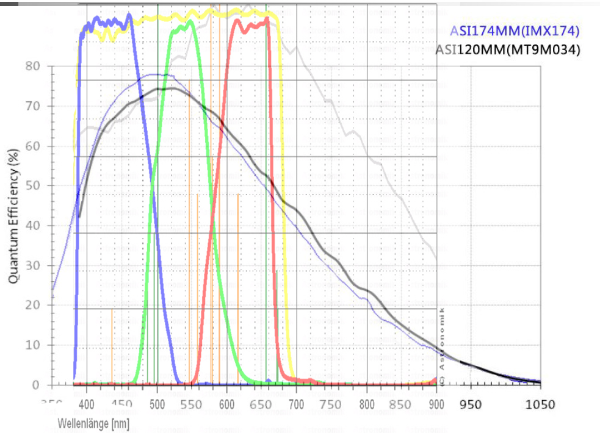
| When I take planetary images I want to make good use of my camera's well capacity so I don't set the exposure time so low that the well capacity isn't well used But I don't want to saturate any pixels so I don't set the exposure time too high. I choose an exposure time (different for each filter) such that the brightest pixels are about 80% to 85% of full well capacity for each. Since the brightest parts of a Jupiter image in each filter are the zones, that means for the brightest zones.I am choosing capture parameters such that Red ADU = Green ADU = Blue ADU I am making the zones white, but are they really? And how am I affecting the color of the rest of the image? My filters have about the same QE one to the other, but my camera (ASI174 MM with Sony IMX174 CMOS Sensor) has a lower QE in Blue than in Green and lower in Red than in Blue. The confusing image below shows Camera QE for the camera used, the ASI 174MM (the camera with the higher QE at 500nm) superimposed on the pass bands of the Astronomiks R,G,B and L filters. |
| Celestron C14, Televue 3x Barlow, ASI 174MM camera, Astronomiks R, G and B filters. This is less processed than most of my images, but I didn't want to risk changing the color balance. Do you think those are the colors you see at the eyepiece? |
| To try to calibrate the true R:G:B ratio, correcting for Camera QE, for differential atmospheric absorption and hopefully for everything else I imaged several stars at about the same Alt as Jupiter, each star imaged with the same gain and exposure time for the Red, Green and Blue filters. I then measured the total ADU in the star image (less background). I used SIMBAD: http://simbad.u-strasbg.fr/simbad/sim-id?Ident=Hip+54872&submit=submit+id VizieR Online Data Catalog: Catalogue of Stellar Photometry in Johnson's 11-color system. Authors: Ducati, J. R. Publication: CDS/ADC Collection of Electronic Catalogues, 2237, 0 (2002) Publication Date: 00/2002 Origin: SIMBAD Keywords:Photometry: UBVRIJKLMNH Comment: colors.dat 3945x132 Photometric data in the BVRIJHKLMN colors to determine the true B V and R magnitudes of those stars. (My usual planetary imaging filters - Astronomiks R,G,B - are pretty close to the Sloan Cousins B V and R filters.) I came up with a correction factor for each filter. I am a bit suspicious of the results, since they indicated I should multiply the V/Green value by 1.31 and the R image by 2.05 which is more than the QE graph above would suggest, But I am correcting not just for camera QE but for the atmospheric scattering, for all glass in the pathway etc. Maybe that is accurate. Here is the result: |